
The FEAR Act & Your Teen’s Digital Privacy: What UK Parents Need to Know
The UK government can now monitor your teen’s online activity—and most parents have no idea.
In early 2025, the Public Authorities (Fraud, Error and Recovery) Act—nicknamed the FEAR Act—quietly expanded government surveillance powers to an unprecedented level. While sold as a tool to combat benefit fraud, the Act gives authorities sweeping access to financial records, digital transactions, and online behaviour.
But here’s what most parents don’t realise: These powers don’t just apply to adults. They extend to anyone connected to a monitored account—including teenagers.
If you receive any form of state support (Universal Credit, Child Benefit, PIP, tax credits), the Department for Work and Pensions (DWP) now has the legal authority to:
- Monitor bank accounts, PayPal, and digital wallets
- Track spending patterns and online transactions
- Access data from payment processors without prior suspicion
- Flag “unusual” activity for investigation
This raises serious questions about teen privacy, digital rights, and the boundaries of state surveillance.
As a parent, you need to understand how this law affects your family—and why teaching your teen smart digital habits matters more than ever.
What Is the FEAR Act?
The Public Authorities (Fraud, Error and Recovery) Act 2025 grants government agencies—primarily the DWP and HMRC—the power to compel banks and financial institutions to:
- Conduct algorithmic monitoring of millions of accounts
- Share data on transactions, balances, and spending patterns
- Flag accounts for investigation based on automated risk assessments
The official goal? To detect benefit fraud and overpayments.
The concern? Mass surveillance without suspicion, targeting some of the UK’s most vulnerable families.
Civil liberties groups like Big Brother Watch have warned that the Act subjects millions of people—including children—to invasive monitoring simply because their household receives state support.
How Does This Affect Teens?
1. Guilt by Association
If your household receives benefits, your teen’s online activity may be monitored if linked to a family account or payment system.
This includes:
- PayPal transactions (birthday money, selling old games, freelance work)
- Bank transfers (pocket money, part-time jobs)
- Digital purchases (in-app purchases, subscriptions, online shopping)
Even innocent activity can trigger algorithmic flags—especially if a teen earns money online, receives gifts, or makes frequent transactions.
2. Chilling Effect on Independence
Teens learning financial responsibility—saving, budgeting, earning pocket money—now face the reality that their transactions may be scrutinised by government algorithms.
This creates a chilling effect: teens may avoid legitimate online earnings (tutoring, selling crafts, small freelance work) out of fear it could trigger an investigation into their family.
3. Digital Rights Erosion
The FEAR Act normalises mass surveillance. Teens growing up under this system learn that privacy is conditional—that the state has a right to monitor their digital lives without cause.
This is the new normal. And it’s why teaching teens to protect their privacy, understand their digital rights, and make informed choices online has never been more important.
What Should Parents Do?
1. Talk to Your Teen About Digital Privacy
Don’t wait for a problem to arise. Have an open conversation:
- “The government now monitors online transactions for families receiving benefits.”
- “This doesn’t mean you’ve done anything wrong—it’s about understanding how the system works.”
- “Let’s talk about how to keep your personal info safe online.”
Frame it as empowerment, not fear.
2. Teach Smart Digital Habits
The best defence against surveillance—government or otherwise—is strong digital hygiene:
- Use strong, unique passwords for every account
- Enable two-factor authentication (2FA) on social media, banking, and email
- Avoid oversharing personal details online (school, address, routines)
- Be cautious with public Wi-Fi and shared devices
These habits protect your teen from predators, scammers, and unnecessary scrutiny.
3. Separate Teen Finances When Possible
If your teen earns money (birthday gifts, part-time work, online sales), consider:
- Opening a separate teen bank account (many banks offer these from age 11-13)
- Using cash for small transactions when practical
- Keeping records of legitimate earnings (tutoring, babysitting, selling items)
This creates a clear paper trail and reduces the risk of algorithmic false positives.
4. Know Your Rights
If your family is flagged or investigated:
- You have the right to ask why your account was flagged
- You can request details of the data collected and how it was used
- Civil liberties organisations (Big Brother Watch, Liberty) offer guidance and support
Don’t assume the algorithm is always right. False positives happen—especially with automated systems.
Why This Matters for Online Safety
The FEAR Act highlights a broader truth: your teen’s digital footprint matters.
Every transaction, post, search, and message leaves a trace. Whether it’s government surveillance, corporate data mining, or online predators—teaching teens to control their digital presence is critical.
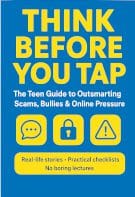
Think Before You Tap is a practical guide that empowers 11-16 year olds to:
- Understand their digital footprint and how it’s tracked
- Protect personal information from surveillance and exploitation
- Navigate privacy settings, passwords, and two-factor authentication
- Make informed choices about what they share online
The book doesn’t preach fear—it teaches control. Teens learn to take ownership of their digital lives, understand the risks, and build habits that protect them from predators, scammers, and invasive surveillance.
Get your copy on Amazon or read free with Kindle Unlimited.
Free teaching resources for schools and youth organisations available at netneo.co.uk.
The Bigger Picture
The FEAR Act is just one piece of a growing surveillance landscape. From social media algorithms tracking behaviour to schools monitoring online activity, teens are growing up in a world where privacy is increasingly rare.
But knowledge is power.
By teaching your teen to understand digital rights, protect personal information, and navigate online spaces safely, you’re giving them tools that will serve them for life—whether they’re avoiding predators, protecting against scams, or simply maintaining control over their own data.
Your teen’s privacy matters. Their digital safety matters. And the conversation starts now.
Final Thought
The FEAR Act may expand government surveillance, but it also reminds us why digital literacy is essential. Teens who understand how their data is tracked, shared, and monitored are better equipped to protect themselves—not just from the state, but from anyone trying to exploit their online presence.
Start the conversation today.